

Why Are My Teeth Suddenly Sensitive to Cold?
The first sip of iced water on a hot afternoon. A spoonful of ice cream you had been looking forward to all day. A single breath of January air on the walk to the bus. Then it arrives without warning, a bright jab of pain that shoots up from one tooth and vanishes almost before you can react, leaving you to freeze, wait, and wonder what on earth just happened.
Here is the part most people miss. A tooth that suddenly flinches at cold did not break overnight; it has been sending up a small flare, a signal that something in its outer defences has been wearing thin for weeks or months. Learning to read that signal is the difference between an easy fix now and a bigger appointment later. This guide follows the cold from the surface of the tooth down to the nerve, so you can work out exactly what your mouth is trying to tell you, why the pain can appear so abruptly, and what actually settles it for good.
That Jolt of Pain, Explained
Every tooth is built in layers, and understanding those layers is the key to understanding the pain. The hard white enamel you can see is only the outer shell. Underneath lies a softer, living layer called dentin, and running through it are thousands of microscopic channels known as tubules. Those tubules lead straight to the nerve at the centre of the tooth. As long as enamel above the gum line and healthy gum tissue below it keep the dentin sealed off, the nerve stays quiet and cold never bothers you.
The trouble starts when dentin becomes exposed. When cold reaches an open tubule, the fluid inside it shifts, and that tiny movement tugs on the nerve like a bell rope. The result is the sensation dental researchers describe as a short, sharp pain that fades the moment the trigger is gone. That definition comes from the Canadian Advisory Board on Dentin Hypersensitivity , whose consensus work on the condition is published through the Journal of the Canadian Dental Association.
A Quick Flash Versus a Deep Ache
The character of the pain is the single most useful clue you have, and it is worth learning to tell the two apart before anything else. The everyday kind is a brief, sharp zing that appears the instant cold touches the tooth and disappears just as fast, which points to exposed dentin and is the type most of this page is about. The kind to watch is a dull ache that builds and then lingers for many seconds, or even minutes, after the cold is gone. Pain that outlasts the trigger suggests the nerve itself is irritated, and it deserves a closer look. Keep that distinction in mind as you read on, because it comes back at the end and it changes what you should do next.
Find our Dental Clinic Near You
Why It Hits You All of a Sudden
Sensitivity rarely announces itself in advance, which is why it feels so abrupt. In most cases, the groundwork was laid quietly over months, and only crossed a threshold recently. If your teeth were fine last week and flinching today, one of these triggers has usually tipped the balance:
- A recent whitening treatment can briefly open the enamel and leave teeth sensitive to cold for a few days; if your sensitivity began soon after brightening your smile, our page on teeth whitening explains what is normal and what is not.
- A firmer toothbrush or a heavier hand , since a new hard-bristled brush or simply scrubbing harder than your enamel and gums can take wears the surface down faster than most people expect.
- A hairline crack too fine to see, which can open a fresh path to the dentin that cold often finds first.
- Recent dental work , as a filling or crown placed in the last week or two, can leave a tooth briefly touchy while it settles.
- The change of season , when a blast of cold winter air on the walk outside is sometimes all it takes to reveal a problem that was already there.
Any one of these can be the final nudge that turns a hidden weakness into a very noticeable one. The trigger you noticed is rarely the whole story; it is simply the moment the underlying cause finally made itself felt.
What's Really Causing It: The Common Culprits
Cold sensitivity is a symptom, not a diagnosis, and it can trace back to several very different sources. Understanding which one is behind your discomfort matters, because the right fix depends entirely on the cause. Broadly, the culprits fall into two groups: things that wear enamel away from above, and things that expose the root from below.
When Enamel Wears Thin
Enamel is the toughest substance in the body, but it does not grow back once it is gone, and three things wear it down most often. Acid erosion is the quiet one: soft drinks, citrus fruit, wine, and sports drinks all lower the pH in the mouth and soften enamel; over time, the surface thins enough to let cold reach the dentin. The Ontario Dental Hygienists' Association lists these same acidic foods and drinks among the leading causes of enamel erosion. Tooth decay is the second, because a cavity breaks through enamel and gives cold a direct path inward, so sensitivity that steadily worsens or centres on a single spot can be an early sign. The third is grinding and clenching, often during sleep, which slowly flattens and cracks the enamel, leaving teeth sensitive to temperature and sometimes sore in the morning.
When the Root Is Exposed
Below the gum line, the tooth has no enamel at all. The root is covered only by a thin layer called cementum, and once the gum pulls back and uncovers it, that surface becomes far more porous and sensitive. Gum recession is the main driver: as the gum line recedes, it exposes the root and the dentin just beneath it, and even a small amount can make cold feel unbearable, which is one of the most common reasons a tooth becomes sensitive. A cracked or chipped tooth is the other, because a crack that extends toward the root can open a channel straight to the nerve, and cracks are notoriously hard to spot without a dental exam.
Of these causes, gum recession deserves the closest look, because it is both extremely common and easy to ignore until the sensitivity sets in. Its link to cold pain is not merely anecdotal. In a study of adults across thirty-seven general dental practices, researchers found that people with gingival recession were more than five times as likely to have dentin hypersensitivity as those without it , the strongest single association the study identified. It is also the cause that our own patient photographs illustrate most clearly, so it is worth understanding in a little more depth.
Gum Recession and Cold Sensitivity: A Real Result From Our Clinic
Gum recession happens when the gum tissue that should hug each tooth gradually pulls away, exposing the root underneath. It tends to creep in so slowly that most people never notice the gums themselves changing. What they notice is the consequence: a tooth that suddenly cannot tolerate cold water, or a twinge along the gum line while brushing. By then the root is already uncovered and reacting.
Several everyday habits and conditions drive it. Brushing too hard with a stiff-bristled brush wears away the delicate gum margin over time, and gum disease, a bacterial infection that inflames and destroys gum tissue, is the leading cause. Grinding, tobacco use and simply having naturally thin gum tissue all add to the risk. Because receding gums do not grow back on their own, the exposed root stays sensitive until the gum line is physically restored, which is where clinical treatment comes in.
A Real Result From Our Clinic
The two images below were taken here at Bayview Smile Centre, before and after we treated one of our own patients for gum recession. This person came to us describing exactly the symptom this article opens with: a sharp, unpredictable reaction to anything cold, concentrated along the gum line of the upper front teeth. Rather than manage the pain with toothpaste alone, our clinicians treated the cause, and the pair of photographs captures the entire arc of why cold sensitivity happens and how it is resolved at the source.
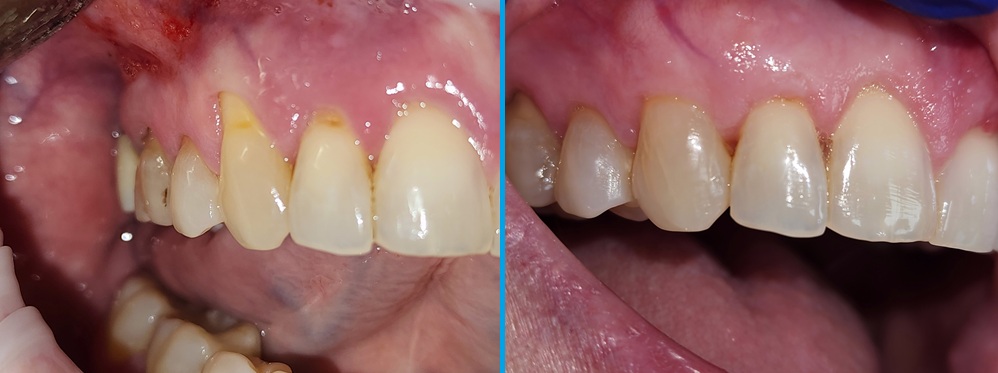
In the before image, the gum tissue has retreated toward the root, leaving the necks of the front teeth exposed and standing longer than they should. That uncovered surface is precisely the part of the tooth with no enamel to protect it, which is why it reacted to a mouthful of cold water with a jolt of pain, and you can see the faint yellowing where the porous root shows through.
The afterimage shows the same mouth after our team rebuilt the gum line with a root coverage procedure, which repositions healthy tissue back over the exposed root and secures it as it heals. The tissue now covers and cushions the roots that were reacting; the teeth look shorter and more even, and, most importantly for the patient, the surface that used to flinch at cold is protected again. This is the entire purpose of gum recession treatment: not merely a cosmetic improvement, but a functional one that quiets the sensitivity by addressing its cause rather than masking it. Covering the exposed root is very often what finally settles cold sensitivity for good, because toothpaste can soothe an exposed root, but restoring the gum line is what removes the exposure.
Results vary from person to person, and only an in-person examination can determine whether recession is behind your own sensitivity and what the right approach would be. This patient's outcome makes clear that exposed roots are treatable and that the discomfort they cause does not have to be permanent.
When One Cold Tooth Means Something Bigger
Most cold sensitivity is the everyday kind that comes from exposed dentin, and it behaves in a predictable way. The pain is brief, it fades the instant the cold is gone, and it often affects several teeth at once, especially near the gum line. It is annoying, but rarely urgent. A different pattern, though, is your tooth asking for help, and it pays to recognize it.
Think back to the quick flash versus deep ache distinction from earlier. When the pain starts behaving like the second kind, a few signs in particular are worth acting on:
- Lingering pain that carries on for many seconds, or minutes, after the cold has left.
- One tooth, not many , where a single tooth reacts while its neighbours stay comfortable.
- Sensitivity to heat as well as cold , or pain when biting down.
- Spontaneous or night-time pain that throbs on its own and can wake you from sleep.
Any of these can mean the nerve inside the tooth is inflamed rather than simply exposed, which is a very different situation from ordinary sensitivity and one a dentist should assess promptly.
As Dr. Mina Ibrahim, General Dentist of Bayview Smile Centre , explains: "The detail I ask patients about first is not how intense the cold pain is, but how long it lasts after they move the cold away. A zing that disappears within a second or two almost always indicates exposed dentin, which is very manageable. Pain that lingers, throbs, or shows up on its own is the nerve signalling that it is inflamed, and that tooth needs to be seen soon rather than watched. Waiting rarely makes a nerve problem cheaper or simpler to fix."
There is no need to panic, but there is good reason not to wait it out: catching an inflamed nerve early often means simpler treatment and a better outcome. If a tooth is keeping you up at night or the pain refuses to settle, our emergency dental treatment is there for exactly that.
Easing the Sensitivity at Home
While you arrange for the cause to be looked at, a few changes at home can take the edge off. None of these cure the underlying problem, but they can make daily life considerably more comfortable in the meantime.
Choosing and Using a Desensitizing Toothpaste
A toothpaste made for sensitive teeth is the most useful place to start, and it helps to know that they work in one of two ways. Some are built around potassium, which calms the nerve so it fires a pain signal more slowly. Others use stannous fluoride, which physically seals off the open tubules so cold cannot reach the nerve in the first place. Both are effective, and the key detail most people miss is that they need time. The relief builds up over about two weeks of steady, twice-daily use, so switching brands every few days never gives any of them the chance to work. Pick one, use it consistently, and give it a fortnight before you judge it.
Everyday Habits That Help
Alongside the right toothpaste, a handful of small adjustments protect what enamel and gum you still have. Switch to a soft-bristled brush and let the bristles do the work rather than your arm, since gentle, thorough brushing cleans just as well without wearing down the surface. After anything acidic, the Canadian Dental Association advises waiting about thirty minutes before brushing, because enamel is softened right after an acid hit and brushing too soon scrubs it away. Using a fluoride toothpaste and an alcohol-free rinse is gentler on teeth that are already sensitive, and it is worth pausing any whitening while a tooth is flaring up, since bleaching will only add to the reaction until things settle.
If a couple of weeks of diligent home care makes no difference, that in itself is useful information. It usually means the cause is structural, an exposed root, a cavity or a crack, and that it needs to be treated rather than merely managed.
Why Drugstore Fixes Sometimes Fall Short
If you have worked your way through two or three tubes of sensitivity toothpaste and the cold jab keeps coming back, the problem is usually not that you chose the wrong brand. It is that toothpaste, by design, can only reach so far. A desensitizing paste either calms the nerve or lays down a thin, temporary seal over the tubules, and both effects are worn away a little with every meal, every acidic drink and every brushing. When the dentin is only mildly exposed, that is often enough. When a root is fully uncovered, or a cavity has opened a direct channel, a surface coating is simply outmatched.
The difference is measurable. In a controlled clinical trial, patients using a desensitizing toothpaste on its own recorded only a small change in their pain over a month, while those who also received a professionally applied fluoride varnish reported a far larger reduction, on the order of a seventy percent drop in pain compared with two percent for toothpaste alone . The reason is straightforward: an in-office varnish is far more concentrated than anything sold over the counter; it is applied directly to the tooth that is actually reacting, and it is left undisturbed to bond rather than being rinsed and brushed away hours later.
None of this means toothpaste is pointless. It remains the sensible first step and the best way to keep discomfort at bay while you arrange a visit, and for genuinely mild cases, it may be all you ever need. The point is a practical one about expectations. If two weeks of consistent, correct use has not moved the needle, that is your cue that the cause is structural and that a treatment aimed at the tooth itself, rather than a coating you reapply each morning, is what will finally end it.
How a Dentist Puts a Stop to It
Home care manages the symptom. Ending the sensitivity means treating whatever is letting cold reach the nerve, and that is where a proper diagnosis earns its keep. Because the causes are so different, the treatments are too, and matching the right one to your particular tooth is the whole purpose of an examination. These are the options a dentist weighs up:
- Fluoride varnish or a professional desensitizer for teeth worn thin or reactive at the gum line, sealing the tubules far more effectively than toothpaste alone.
- A filling , when a cavity is the culprit, cleans out the decay and seals the path that cold was travelling.
- Gum recession treatment when receding gums have exposed the roots, restoring the gum line and addressing the sensitivity at its source, the same result shown in the photographs above.
- A bonded repair or crown for a cracked tooth, using bonding or, if the crack runs deeper, porcelain crowns to cover and stabilize it.
- A custom night guard for grinding, worn during sleep to shield the enamel from further wear.
- Root canal treatment when the nerve itself is inflamed or infected, which removes the pain and saves the tooth.
Deciding among these is a conversation best had in the chair, once a dentist has seen which tooth is involved and why. You can meet the people who would guide you through it on our dental team page.
Keeping Cold Sensitivity from Coming Back
Once a tooth has been settled, a little routine keeps it that way. Prevention comes down to protecting enamel from above and gums from below, the same two fronts where sensitivity begins. That means going easy on acid and rinsing with water afterward to help your mouth return to balance more quickly, brushing twice a day gently with a soft toothbrush and a fluoride toothpaste, and treating the gum line as carefully as the teeth themselves, since guarding your gums guards the roots beneath them.
The steadiest safeguard, though, is a regular professional cleaning and check-up. Routine visits catch thinning enamel, early recession and small cracks long before they turn into a cold-weather ambush, and they give your dentist the chance to strengthen vulnerable teeth in advance. A dental cleaning every six months is one of the simplest ways to keep sensitivity from creeping back, and for patients in Bayview Village, those regular visits are the quiet backbone of a comfortable, pain-free smile.
The Bottom Line on Cold-Sensitive Teeth
If there is one idea to carry away from this guide, it is that a cold-sensitive tooth is information, not just an inconvenience. The pain is your enamel or your gum line reporting that the dentin underneath has been left exposed, and the two-second flash that most people feel is both the most common version and the most treatable. The length of the pain tells you almost everything about how urgent it is: a quick zing points to a surface problem you can begin managing at home tonight, while an ache that lingers, throbs, or wakes you points to the nerve and to a visit that should not be put off.
The encouraging part is that cold sensitivity is one of the most fixable complaints in dentistry, provided the real cause is found rather than merely muffled. Whether the answer turns out to be a desensitizing toothpaste, a filling, a restored gum line like the one in our patient's photographs, or something else entirely, the discomfort does not have to be a permanent feature of your winters or your ice cream. If the cold has started to sting, let our team in Bayview Village take a proper look while the fix is still small.
Frequently Asked Questions
Will cold sensitivity go away on its own?
Sometimes, if the cause is temporary, such as a recent whitening session or a short spell of aggressive brushing, it can ease within a couple of weeks. When it lingers beyond that or keeps returning, the dentin remains exposed, and the tooth needs a proper look rather than more waiting.
Can teeth whitening cause sensitivity?
Yes, and it is one of the more common triggers. Whitening can leave teeth temporarily reactive to cold while the enamel settles, which usually passes within a few days. Sensitivity that drags on well past that point is worth mentioning to your dentist.
Why does only one tooth react to cold?
A single reactive tooth stands apart from the general kind of sensitivity that affects several teeth together. It can point to a specific problem in that one tooth, such as a cavity, a crack or an inflamed nerve, and it deserves closer attention, especially if the pain lingers after the cold is gone.
Does cold sensitivity mean I need a root canal?
Not usually. Ordinary cold sensitivity arises from exposed dentin and is often managed with simple measures. A root canal enters the picture only when the nerve itself is inflamed or infected, which tends to show up as pain that lingers after the cold is gone, throbs on its own, or reacts to heat as well.
Can sensitive teeth be fixed permanently?
In most cases, yes. Once the underlying cause is identified and treated, whether that is worn enamel, a cavity, gum recession or a crack, the sensitivity typically resolves. Keeping it away long-term comes down to gentle brushing, a mindful diet and regular check-ups.